Starting Startups
Integrating People, Product, and Position for Success
A practical framework for founders and boards to make decisions stick, reduce re-decisions, and keep speed sustainable as complexity rises.
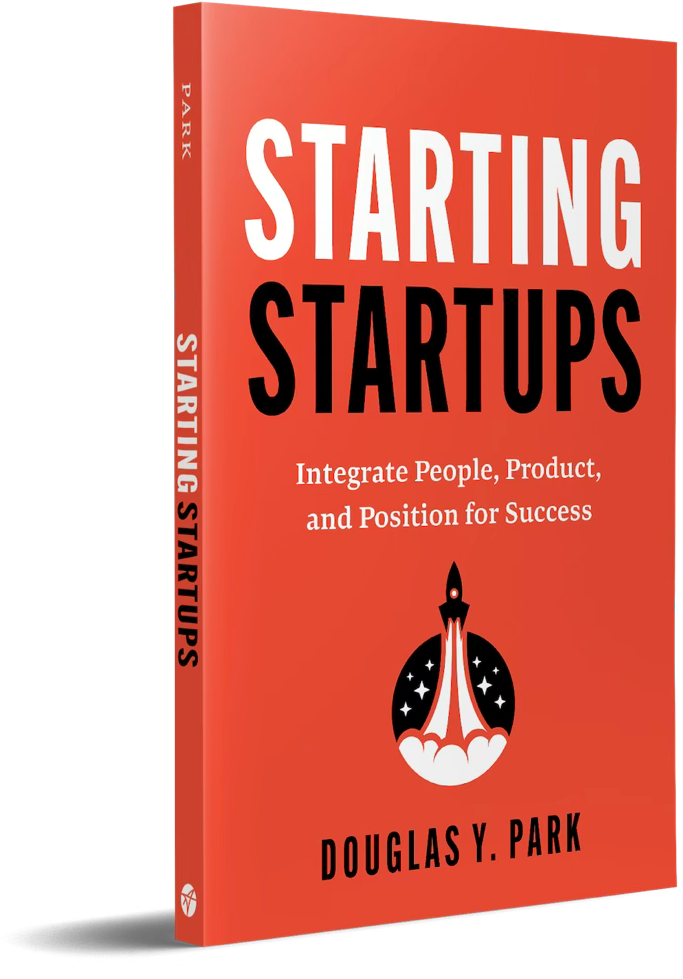
About the Book
An evidence-based framework for startups. The premise is simple: execution is not one thing. It is the outcome of alignment across People, Product, and Position managed as a coherent system rather than silos.
Founders, accelerators, operators, and boards who want decisions to stick, execution to tighten, and speed to stay sustainable.
What readers are saying
"Starting Startups is the rare book that bridges vision and execution. Doug Park distills decades of hard-won insights into a clear, evidence-based roadmap for building companies that last. As a founder and investor, I wish I’d had this playbook earlier—it’s a must-read for anyone serious about turning great ideas into enduring impact."
"As a venture capitalist, I’ve seen how bright people and good ideas still fail without the right framework. In Starting Startups, Douglas Park shows founders how to systematically align team, product, and market strategy while leveraging legal as a force multiplier. This book is a must-read for anyone serious about building not just a startup, but a company that lasts."
"Starting Startups delivers a clear, evidence-based framework that every founder and investor should read. Douglas Park uniquely integrates law, strategy, and organizational science into a practical playbook for building companies that not only attract capital but succeed."
"In a space where speed often beats structure, Starting Startups proves that the smartest founders never treat legal strategy as an afterthought. Doug breaks down how to scale fast while staying aligned, compliant, and fundable. If you’re building in technology, this book isn’t optional — it’s an edge."
"Grounded in evidence-based insights and distilled from decades of legal expertise and real-world startup advising, Starting Startups is a true standout in the crowded world of founder resources. As a former corporate lawyer turned angel investor and strategic advisor, I’ve seen countless founders stumble over the very challenges Park addresses head-on—legal, strategic, and executional. This guide equips founders and ecosystem players with a practical playbook for building companies that are not only fundable but also scalable and durable––I highly recommend it to every founder, investor, and advisor."
What problem the book solves
If your company feels busy but outcomes aren't improving, you're usually dealing with one (or more) of these:
The book gives you a way to diagnose these failures early—before they become culture.
Bring this to your team
Workshops and applied sessions
Tailored for founders, leadership teams, and boards who want to apply the 3P framework immediately.
Workshops & speaking→If execution is leaking right now
Start with a Diagnostic to identify the real bottleneck and get a practical implementation plan.
Advisory inquiry→Book FAQs
Everything you need to know before you read — or right after.
It stands for People, Product, and Position — the three variables that determine whether a company can execute consistently. Most companies treat these as separate functions. The book treats them as one interdependent system.
Yes. The book provides an introduction to how use AI for People, Product, and Position, including operational and legal issues of using AI.
Both. Early-stage teams use it to add structure without slowing down; scaling teams use it to diagnose why growth has stopped converting into outcomes.
Yes. It explains how 3P alignment strengthens credibility and reduces surprises during diligence — because investors are essentially running a 3P audit whether they call it that or not.
Legal structure supports execution — product-market fit, governance mechanics, business model, and go-to-market. The book treats legal as a force multiplier, not a compliance checkbox.
Run the 3P assessment, clarify decision ownership, and identify the highest-leverage bottleneck in your current system. Each chapter ends with a diagnostic you can use the same day.
Practical. The book uses assessments, checklists, and step-by-step sequences to make every concept immediately applicable — not just intellectually interesting.
Let's
talk.
Describe your problem or request for services and I’ll reply.